
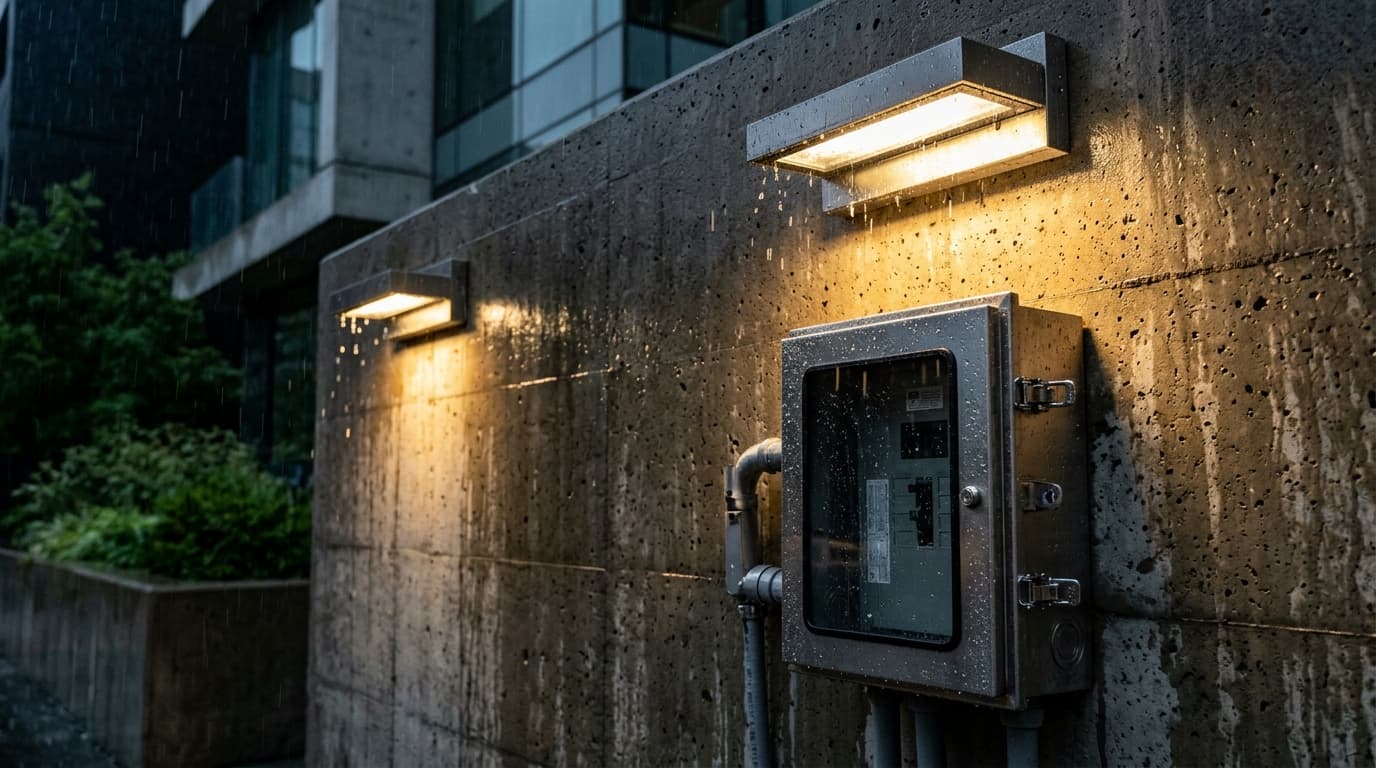
A garden light, a bathroom downlight and an electrical distribution board face very different conditions. One may receive direct rain, another occasional splashes, and the third dust or moisture around its cable entries. Choosing equipment by appearance, wattage or price alone can leave an important question unanswered: how well does its enclosure protect against the conditions around it?
An IP rating helps answer that question. Markings such as IP44, IP54 and IP65 describe specific levels of enclosure protection. Understanding them makes it easier to select suitable equipment, compare quotations and recognise installation details that affect long-term reliability.
For buildings in Kerala, this matters wherever electrical equipment encounters monsoon rain, humid air, garden irrigation or coastal exposure. Each condition needs consideration, and an IP number addresses only part of the picture.
What Is an IP Rating?
An IP rating, commonly called an Ingress Protection rating, classifies the protection provided by an enclosure against access to hazardous parts, the entry of solid foreign objects and the harmful ingress of water.
The internationally recognised framework is IEC 60529: Degrees of protection provided by enclosures (IP Code). It provides a defined classification system instead of relying on broad descriptions such as “weatherproof” or “water-resistant.” Source: IEC 60529.
IP ratings appear on equipment including:
- LED luminaires, floodlights, downlights and outdoor light fittings.
- Distribution boards, control panels and switchgear enclosures.
- Junction boxes, cable glands and electrical connectors.
- Switches, socket outlets, isolators and industrial accessories.
The rating applies to the enclosure in its specified configuration. Covers, seals, mounting orientation and cable connections can all form part of that configuration.
How to Read an IP Rating
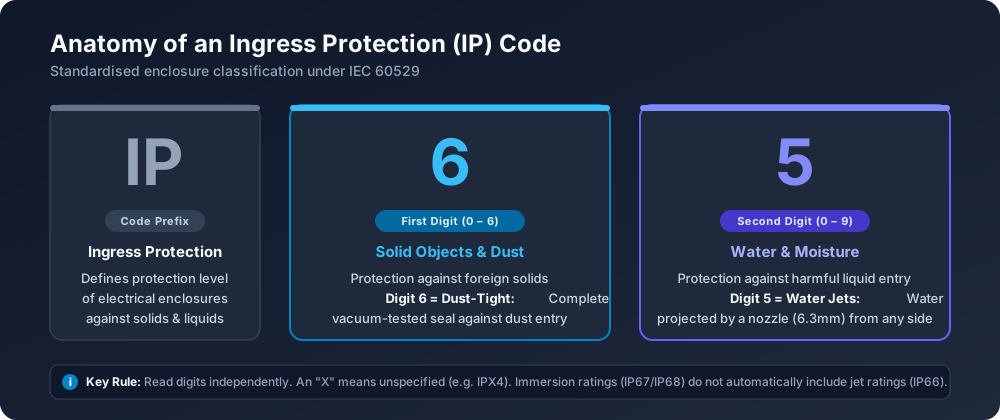
A typical IP code contains the letters IP followed by two digits. Read the digits separately.
For example, IP65 means:
- 6: The enclosure is dust-tight under the specified test.
- 5: It provides protection against water jets under the specified test.
It does not mean “65% waterproof,” and the two digits do not form a single overall quality score.
First Digit: Solid Objects and Dust
The first digit runs from 0 to 6. It relates to solid-object ingress and protection against access to hazardous parts. This table summarises the solid-object aspect:
| First digit | Solid-object protection |
|---|---|
| 0 | No protection against solid-object ingress. |
| 1 | Excludes solid objects measuring 50 mm in diameter or larger. |
| 2 | Excludes solid objects measuring 12.5 mm in diameter or larger. |
| 3 | Excludes solid objects measuring 2.5 mm in diameter or larger. |
| 4 | Excludes solid objects measuring 1 mm in diameter or larger. |
| 5 | Limits dust entry sufficiently to avoid interference with satisfactory operation or safety. |
| 6 | Prevents dust entry under the specified test conditions. |
The distinction between 5 and 6 is useful: a dust-protected enclosure can admit a limited amount of dust, while a dust-tight enclosure must meet the no-ingress criterion. Source: Samsung’s IEC-based rating guide.
Second Digit: Water
The second digit runs from 0 to 9 under IEC 60529. It describes protection against harmful water ingress in defined tests.
| Second digit | Water exposure covered |
|---|---|
| 0 | No water protection. |
| 1 | Water drops falling vertically. |
| 2 | Falling water drops with the enclosure tilted by up to 15°. |
| 3 | Water spray at angles up to 60° from vertical. |
| 4 | Water splashes from any direction. |
| 5 | Water jets from any direction. |
| 6 | Powerful water jets from any direction. |
| 7 | Temporary immersion under specified conditions. |
| 8 | Continuous immersion under specified conditions. |
| 9 | High-pressure, high-temperature water jets under specified conditions. |
These are simplified descriptions. The actual tests specify equipment, exposure conditions and acceptance criteria. A water-protection rating does not always mean that absolutely no water can enter; the relevant requirements concern harmful effects. Source: Intertek’s ingress-protection testing guide.
What Does “X” Mean?
X means that the characteristic is not specified in the code. It is different from zero.
- IPX4 declares splash-water protection without specifying a solids rating.
- IP4X declares the first-digit protection without specifying a water rating.
You may also see additional letters. For example, the B in IPXXB identifies protection against access to hazardous parts with the specified test finger. It does not declare dust or water protection. Source: GAMBICA’s enclosure guide.
Common IP Ratings for Electrical Equipment
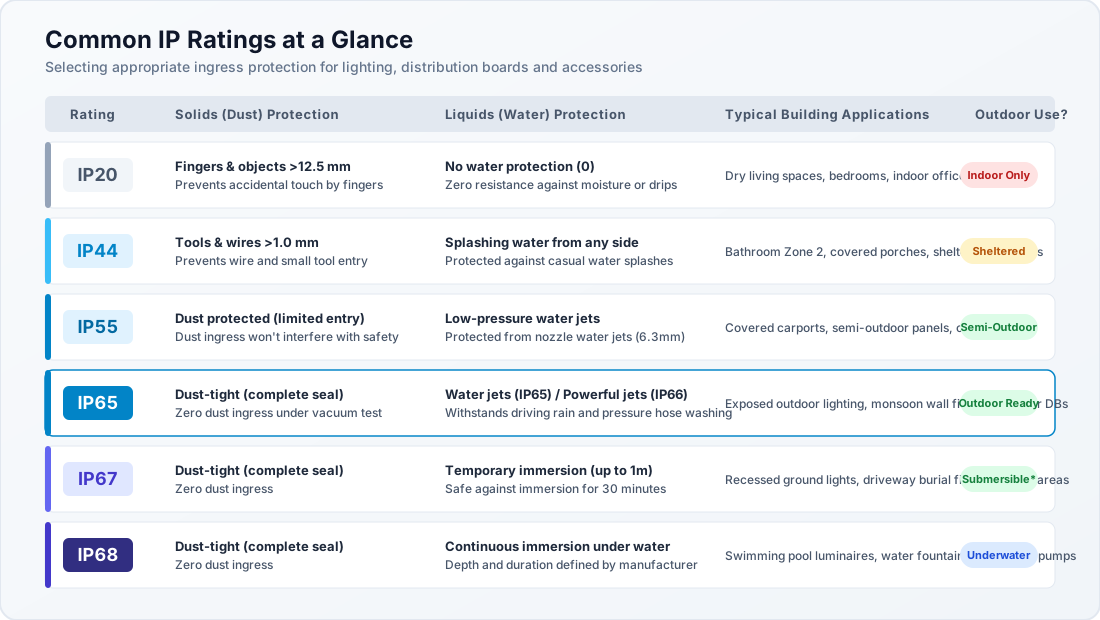
The following combinations frequently appear in lighting and enclosure specifications:
| Rating | Meaning in brief | Main limitation to recognise |
|---|---|---|
| IP20 | Protection against objects of 12.5 mm or larger; no water protection. | Intended location must not require water protection. |
| IP40 | Protection against objects of 1 mm or larger; no water protection. | The higher first digit adds no water resistance. |
| IP44 | Protection against objects of 1 mm or larger and splashing water. | Does not establish dust-tightness or water-jet protection. |
| IP54 | Dust-protected and protected against splashing water. | Limited dust entry is permitted by the classification. |
| IP55 | Dust-protected and protected against water jets. | Dust-tightness is not established. |
| IP65 | Dust-tight and protected against water jets. | Immersion protection is not established. |
| IP66 | Dust-tight and protected against powerful water jets. | Immersion protection is not established. |
| IP67 | Dust-tight and protected against temporary immersion. | Jet protection requires separate confirmation. |
| IP68 | Dust-tight and protected for continuous immersion under specified conditions. | Check the declared immersion conditions. |
| IP69 | Dust-tight and protected against high-pressure, high-temperature water jets. | Other exposure types require confirmation. |
Treat each entry as a description of tested protection. Suitability for a particular building location also depends on the product’s instructions and the wider installation design.
Is a Higher IP Rating Always Better?
Select protection for the actual exposure. A numerically larger code can describe a different type of water test.
IP65 vs IP66
Both are dust-tight. IP65 covers water jets; IP66 covers powerful water jets. The difference matters when assessing cleaning methods and other forceful water exposure.
IP66 vs IP67
IP67 does not automatically include the IP66 jet requirement. Immersion and jet tests stress an enclosure differently. Where both are needed, look for a documented combined declaration such as IP66/IP67. Rockwell Automation explicitly identifies this distinction between jet and immersion ratings. Source: Rockwell Automation reference manual.
IP67 vs IP68
IP67 addresses temporary immersion. IP68 addresses continuous immersion under specified conditions, so the manufacturer’s declared depth, duration and operating limitations matter. IP68 alone does not mean unlimited depth or unrestricted underwater operation.
IP69 vs IP69K
IEC 60529 uses the water designation 9. The 9K designation belongs to the road-vehicle protection framework in ISO 20653, with historical roots in DIN 40050-9. If a product is marketed as IP69K, check which standard and test are declared. Source: ISO 20653.
Choosing IP Ratings for Light Fittings
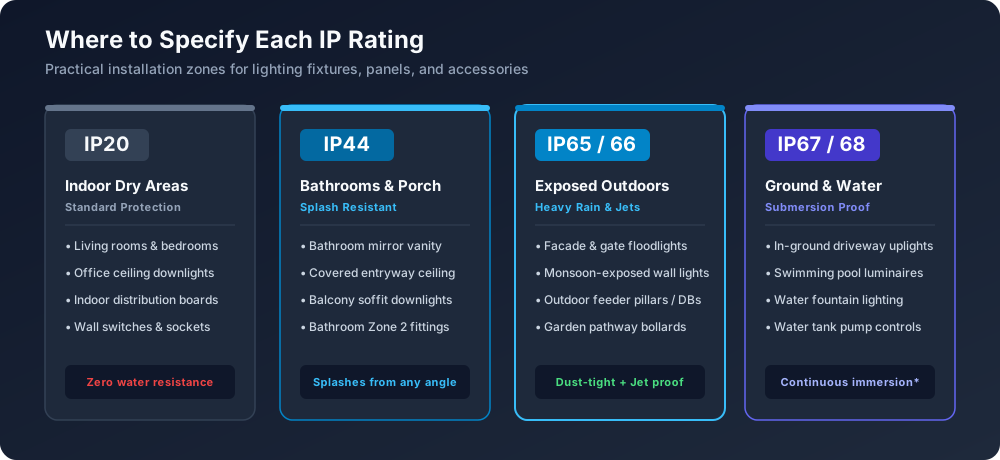
Lighting selection starts with the fitting’s exact position and the water or dust likely to reach it.
Indoor Lighting in Dry Rooms
IP20 fittings are commonly encountered in dry living rooms, bedrooms and offices. A higher degree of ingress protection may be needed where there is dust, splashing, condensation or a particular cleaning process.
“Indoor” is a broad description. A dry office, a commercial kitchen and a washdown area have very different conditions.
Bathroom and Shower Lighting
Bathroom lighting needs assessment against the electrical zones and installation rules applicable to the project. Location relative to a bath or shower affects the permitted equipment and required protection.
IP44 describes splash protection, while IP65 adds dust-tightness and jet protection. Neither marking by itself proves that a fitting is permitted at every bathroom location. The design must also address electrical protection, equipment suitability and any relevant voltage restrictions.
For Kerala projects, use the applicable Indian requirements and site assessment. Bathroom diagrams published for another country should not be treated as local compliance instructions.
Outdoor Wall Lights, Floodlights and Landscape Lighting
An exposed wall light may receive rain from the side. A sheltered porch light may experience occasional splashes. A garden fitting may also encounter sprinkler jets or standing water.
IP65 and IP66 are common options to evaluate for exposed outdoor lighting, but the manufacturer must also approve the fitting for outdoor use. Check mounting orientation, ambient temperature, sunlight exposure, corrosion resistance and connection details.
For recessed ground lights, assess drainage and the likelihood of pooling. If immersion is foreseeable, the selected fitting needs the appropriate documented immersion protection. Drainage remains necessary even when a fitting has a high IP rating.
Underwater and Pool Lighting
Choose equipment specifically designed for the underwater application, with declared immersion conditions and suitable materials. IP68 is relevant to ingress protection, but the complete design also includes the supply arrangement, connections and applicable pool or fountain requirements.
Check Which Part of the Fitting Is Rated
Some recessed lights have different ratings above and below the ceiling. A fitting described as “IP65 from below” may have an IP20 rear section. Manufacturer installation documents demonstrate this arrangement. Source: Philip Payne installation instructions.
Check the light, driver, connector and junction box separately. A protected front face does not establish protection for every component above the ceiling.
Choosing IP Ratings for Panel Boards and Distribution Boards
Panel selection requires attention to the completed assembly, its location and the heat generated inside it.
Match the Enclosure to the Environment
The table below gives illustrative starting points for design discussions, based on the exposure categories. These are not universal minimum requirements.
| Installation conditions | Ratings that may be considered | Further checks |
|---|---|---|
| Dry, clean indoor electrical space | IP30 or IP40, where permitted | Access protection, mounting and ventilation. |
| Dust with occasional splashing | IP54 | Whether limited dust entry is acceptable. |
| Dust with water-jet exposure | IP55 or IP65 | Required dust protection and cleaning conditions. |
| Exposed outdoor enclosure | IP65 or IP66 as possible options | Outdoor suitability, solar heat, corrosion and condensation. |
| Powerful water-jet exposure | IP66 | Actual cleaning pressure, temperature and chemicals. |
| High-pressure hot-water cleaning | Documented IPX9 protection with the required solids rating | Hygienic design and chemical compatibility. |
Where floodwater is foreseeable, consider relocating or raising the equipment as part of the design. An immersion marking alone does not establish that an ordinary distribution board is suitable for continued operation during flooding.
The Finished Panel Must Maintain the Declared Rating
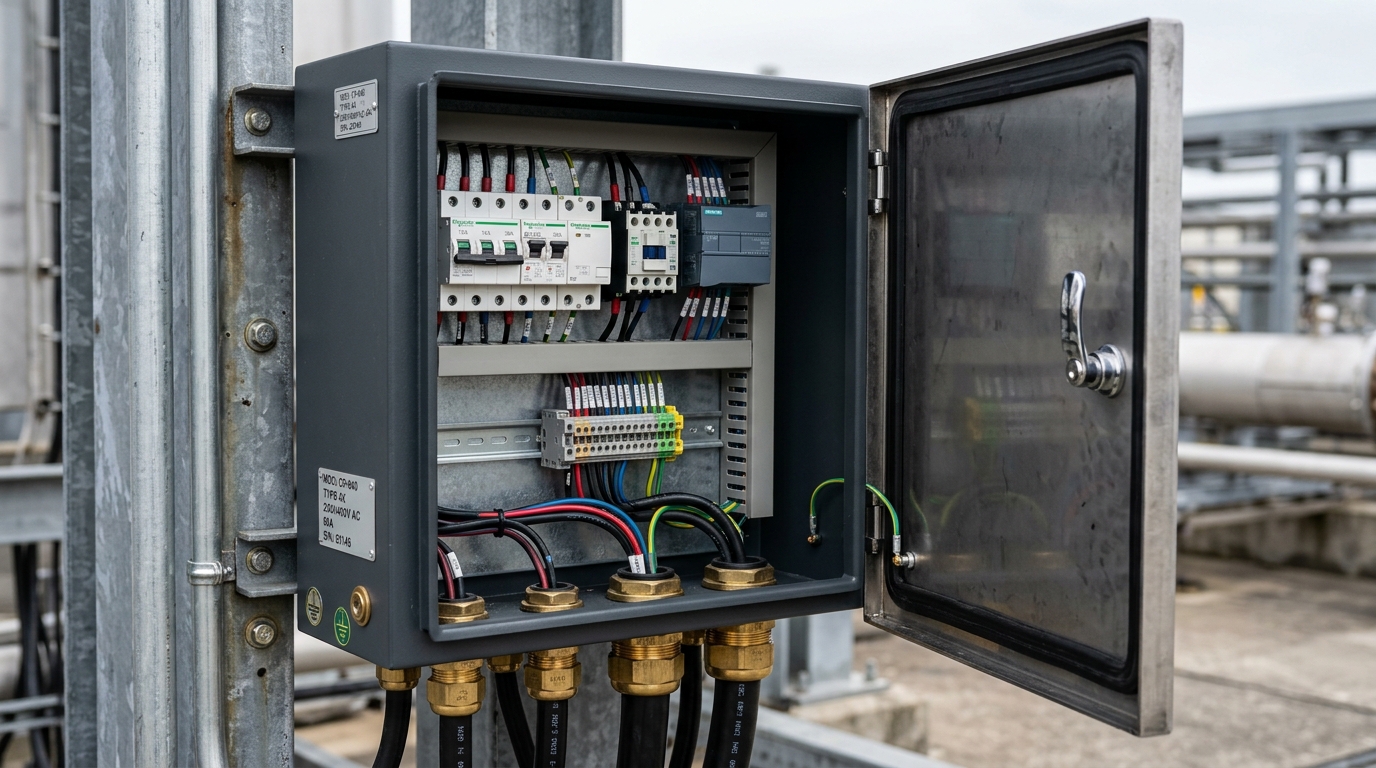
An empty IP65 enclosure does not automatically produce an IP65 completed panel. Door-mounted meters, switches, ventilation devices, gland plates and cable entries must preserve the required protection.
Legrand’s assembly guidance identifies the need to maintain the declared degree of protection after the components are installed. Source: Legrand’s IEC 61439-2 assembly guide.
The distinction also applies to operating states. Protection with an outer door closed may differ from protection with the door open. Internal barriers and covers require their own assessment.
Balance Sealing and Heat Dissipation
A panel must dissipate heat from its devices, busbars and connections. Changing to a more tightly sealed arrangement can change its thermal performance.
The panel builder should verify temperature rise for the actual enclosure, installed equipment, loading and ambient conditions. Adding an unassessed ventilation opening can compromise ingress protection; sealing an opening can compromise cooling. Both changes need engineering review. Source: Schneider Electric on IEC 61439 and temperature rise.
Plan for Condensation
A water-resistant enclosure can still develop condensation when humid air inside cools below its dew point. IP protection does not establish control of internal humidity.
Depending on the design, suitable measures may include controlled heating, compatible pressure-equalisation devices or other manufacturer-approved moisture-management arrangements. These measures must preserve the intended enclosure protection. Source: Rittal on condensation in enclosures.
Switches, Sockets, Junction Boxes and Cable Glands
Small accessories deserve the same attention as the main fixture or panel.
Switches and sockets: Confirm whether the rating applies with the cover closed, with a plug inserted, or in both states. A closed-cover rating may not describe the socket while it is in use.
Junction boxes: Check lid seals, cable-entry arrangements and the installation position. A rated box with an unsealed entry cannot be assumed to retain its declared protection.
Cable glands: Select a suitable gland for the cable diameter, entry thread, enclosure interface and required protection. A high rating printed on the gland does not correct an incompatible cable or poor installation.
Connectors: Check whether protection depends on the connector being fully mated, locked or fitted with a sealing cap. Maintenance and disconnected states may have different limitations.
These details should be resolved during selection so that installers can follow a complete, compatible arrangement.
What an IP Rating Does Not Tell You
An IP code describes particular enclosure protection. Other performance characteristics need separate evidence.
| Consideration | What to check separately |
|---|---|
| Mechanical impact | The relevant IK rating and product requirements. |
| Corrosion and coastal exposure | Material, coating, fasteners and corrosion-test information. |
| Sunlight and outdoor ageing | UV suitability and the manufacturer’s outdoor-use declaration. |
| Heat | Ambient limits, thermal design and any derating requirements. |
| Chemicals and cleaning agents | Compatibility of seals, housing and other exposed materials. |
| Explosive atmospheres | Appropriate hazardous-area protection and certification. |
| Electrical safety | The relevant product standard, insulation, protective earthing where required and circuit protection. |
IP and IK are separate classifications: IEC 60529 addresses ingress, while IEC 62262 addresses mechanical impact. Source: Schneider Electric’s enclosure-protection guide.
Similarly, an IP marking is one part of luminaire selection. General luminaire safety is addressed by the IEC 60598 framework and applicable national product requirements. Source: IEC 60598-1.
IP Ratings vs NEMA Enclosure Types
Some imported equipment carries a NEMA enclosure Type designation. The NEMA and IP systems are not directly interchangeable because their requirements differ.
NEMA classifications can address characteristics beyond IP testing, including corrosion and icing. An IP66 marking, for example, does not by itself establish compliance with NEMA Type 4X. Verify the classification actually required by the project rather than relying on an approximate conversion chart. Source: Rittal’s IP and NEMA comparison.
Installation Mistakes That Can Compromise Protection
The following details should be checked during installation and handover:
- Unsealed openings: Spare entries, missing blanking plugs and unused cut-outs provide paths into the enclosure.
- Incorrect glands: The gland must suit both the cable and its connection to the enclosure.
- Damaged or displaced gaskets: A twisted, dirty or hardened seal may prevent proper closure.
- Incorrect tightening: Follow the manufacturer’s specified tightening instructions; excessive force can damage parts.
- Wrong mounting orientation: The declared protection may depend on how the product is installed.
- Unassessed modifications: Drilled holes, replacement covers, fans and door-mounted devices can affect the original arrangement.
- Exposed external connections: A rated fixture still needs appropriately protected cable joints and accessories.
- Poor maintenance: Corrosion, cracked covers and deteriorated seals can reduce protection over time.
Improvised sealing should not replace the manufacturer’s specified sealing system. For monsoon preparation, include external fittings, enclosure closures and cable entries in a planned inspection by a qualified electrical professional.
A Practical Selection Checklist
Before approving a light fitting, accessory or panel board, establish:
- The exact location: Indoors, sheltered outdoors, fully exposed, below ground or underwater.
- The solids exposure: Ordinary objects, occasional dust or a need for dust-tight protection.
- The water exposure: Drips, splashes, jets, temporary immersion or continuous immersion.
- Other conditions: Temperature, sunlight, salt, chemicals, impact and condensation.
- The rated configuration: Covers, doors, mounting position, connectors and cable entries.
- The supporting evidence: Product datasheet, applicable standard, installation instructions and relevant test documentation.
- The complete installation: Compatible accessories, thermal performance and electrical protection.
- The maintenance needs: Access for inspection, suitable replacement seals and a practical service plan.
Ask for documentation matching the exact model and configuration being supplied. An IP marking is a performance declaration; it does not by itself identify the laboratory, certification route or installation conditions.
Frequently Asked Questions
Is IP65 Waterproof?
IP65 means dust-tight with protection against water jets under specified conditions. It does not establish immersion protection. “Waterproof” without defined conditions is too broad to describe its performance accurately.
Is IP44 Suitable for Outdoor Lighting?
It can be suitable for some locations when the manufacturer permits outdoor use and the expected exposure is within its capabilities. Direct exposure, cleaning jets or dust may justify a different specification.
Does IP67 Include IP66 Protection?
No. Confirm jet protection separately, or choose equipment with a documented combined rating where both exposure types are relevant.
Can IP68 Equipment Stay Underwater Indefinitely?
IP68 requires declared immersion conditions. Follow the specified depth, duration and operating limitations, and confirm that the complete product is intended for the application.
What IP Rating Does an Outdoor Panel Board Need?
There is no single rating for every outdoor panel. IP65 or IP66 may be considered for some installations, alongside exposure, product suitability, corrosion, condensation, temperature rise and applicable requirements.
Does a Higher IP Rating Replace Earthing or RCCB Protection?
No. Enclosure protection, protective earthing where required, overcurrent protection and residual-current protection perform different functions. The installation design must address each relevant requirement.
Can an IP Rating Reduce After Installation?
The declared protection can be compromised by modifications, incompatible accessories, damaged seals or deterioration. Installation and maintenance must preserve the rated arrangement.
Specify the Right Protection for Your Building
A suitable IP rating starts with understanding where the equipment will be installed and what can reach it. The next step is to verify the complete product and preserve its protection through correct installation and maintenance.
For a home, commercial building or industrial project, a clear specification helps everyone involved make consistent decisions—from the designer and purchaser to the panel builder and installer.
Planning electrical or lighting work in Thrissur or elsewhere in Kerala? Contact V4 Building Solutions to discuss suitable fixtures, enclosure protection and electrical design for your project.