
Have you ever noticed numbers such as 4.6, 8.8, 10.9, or 12.9 stamped on the head of a bolt? Or markings like 8, 10, A2-70, or A4-80 on nuts and stainless-steel fasteners?
These markings are not random numbers or manufacturing codes. They provide important information about the fastener's mechanical strength, material classification, and suitability for different applications.
Whether you are assembling a steel structure, installing industrial machinery, constructing a building, or working on electrical equipment, understanding these markings can help prevent mechanical failures and improve safety.
In this guide, V4 Building Solutions explains how to read and identify the numbers on nuts and bolts, what they mean, and how to select the correct fastener for your application.
1. Why Are Numbers Written on Bolts?
Bolts are manufactured in different strength classes depending on their intended use. For example, a bolt used to assemble lightweight furniture does not require the same strength as a bolt securing a heavy industrial machine or structural steel connection.
To identify these differences, manufacturers use standardized markings based on specifications such as ISO 898-1 for carbon and alloy steel metric bolts.
These markings help engineers identify:
- Tensile strength of the bolt
- Yield strength or proof stress characteristics
- Strength classification
- Suitability for particular engineering applications
- Applicable fastener standards
However, the markings alone do not specify the correct tightening torque or allowable load for a connection.
2. How to Read the Numbers on a Bolt Head
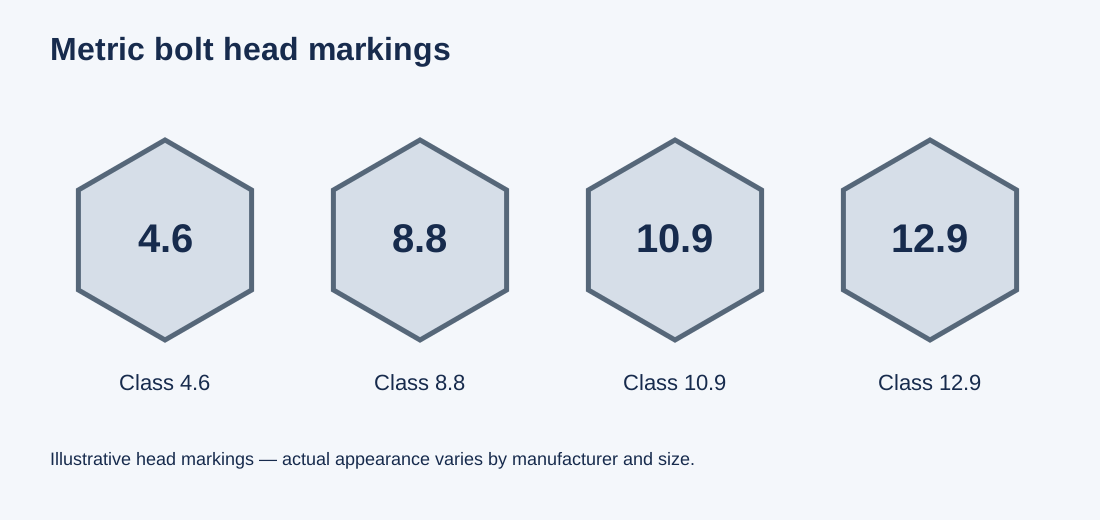
Consider a bolt marked 8.8. This is called the property class of the bolt.
First number: 8
Multiply the first number by 100 to obtain the nominal ultimate tensile strength in megapascals (MPa):
8 × 100 = 800 MPa
Second number: 8
The second number represents one-tenth of the nominal yield-to-tensile-strength ratio:
8 ÷ 10 = 0.8
Therefore:
800 × 0.8 = 640 MPa
| Property | Nominal value |
|---|---|
| Tensile strength | 800 MPa |
| Yield strength | 640 MPa |
| Yield-to-tensile ratio | 80% |
These are nominal values used to explain the class designation. Minimum specified mechanical properties may differ under the applicable ISO standard.
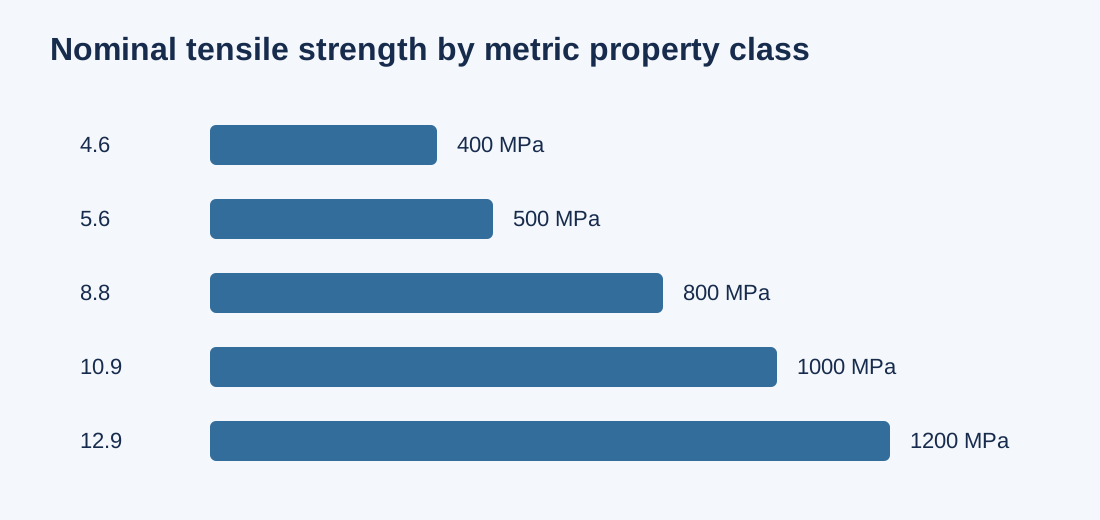
3. Common Bolt Grades and Their Strength
| Bolt class | Nominal tensile strength | Nominal yield strength |
|---|---|---|
| 4.6 | 400 MPa | 240 MPa |
| 5.6 | 500 MPa | 300 MPa |
| 8.8 | 800 MPa | 640 MPa |
| 10.9 | 1,000 MPa | 900 MPa |
| 12.9 | 1,200 MPa | 1,080 MPa |
These values illustrate the property-class numbering system. Actual specification and acceptance requirements must be checked against the applicable standard.
A higher property class generally indicates higher strength, but that does not mean it is always the best choice. High-strength bolts may require stricter installation controls and can be more sensitive to certain failure mechanisms. The correct grade must be selected based on engineering design requirements.
4. What Do the Numbers on Nuts Mean?
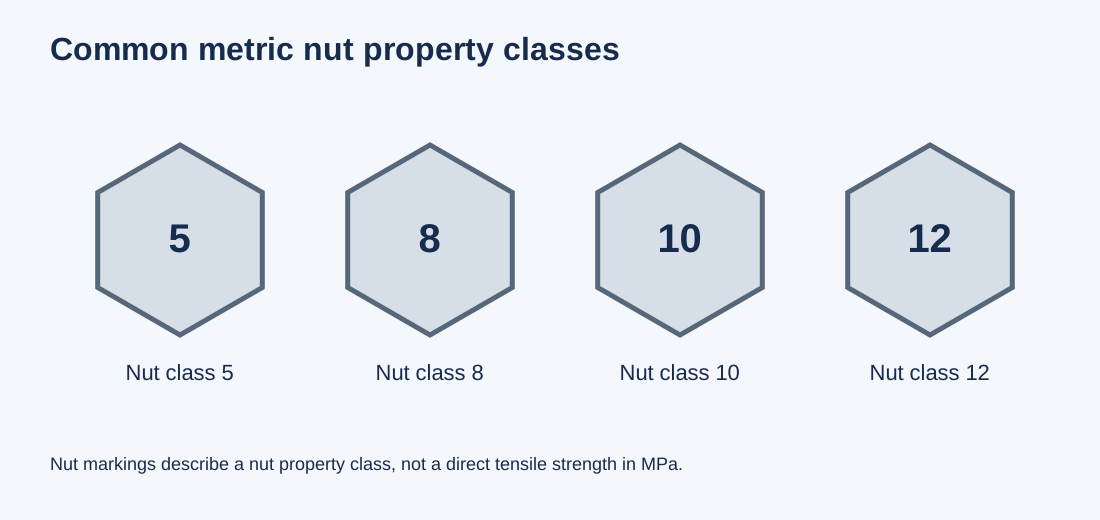
Unlike metric bolts, which commonly have markings such as 8.8 or 10.9, metric nuts are frequently marked with single numbers.
| Nut marking | Property class | General interpretation |
|---|---|---|
| 5 | Class 5 | Lower-strength nut class |
| 8 | Class 8 | Common structural and mechanical fastening class |
| 10 | Class 10 | Higher-strength fastening applications |
| 12 | Class 12 | Very high-strength fastening applications |
Nut classification is governed by standards such as ISO 898-2.
Importantly, a nut marked 8 does not mean that it has a tensile strength of exactly 800 MPa. Nut property classes are based on specified proof-load and assembly performance requirements.
Can an 8.8 bolt be used with a class 8 nut?
In many standard applications, a class 8 nut is a suitable match for an 8.8 bolt, provided the nut type, dimensions, thread, and applicable standard are compatible.
For higher-strength bolts such as 10.9 and 12.9, nut selection must be verified against the relevant standard and design specification.
5. What Does A2-70 or A4-80 Mean on Stainless-Steel Bolts?
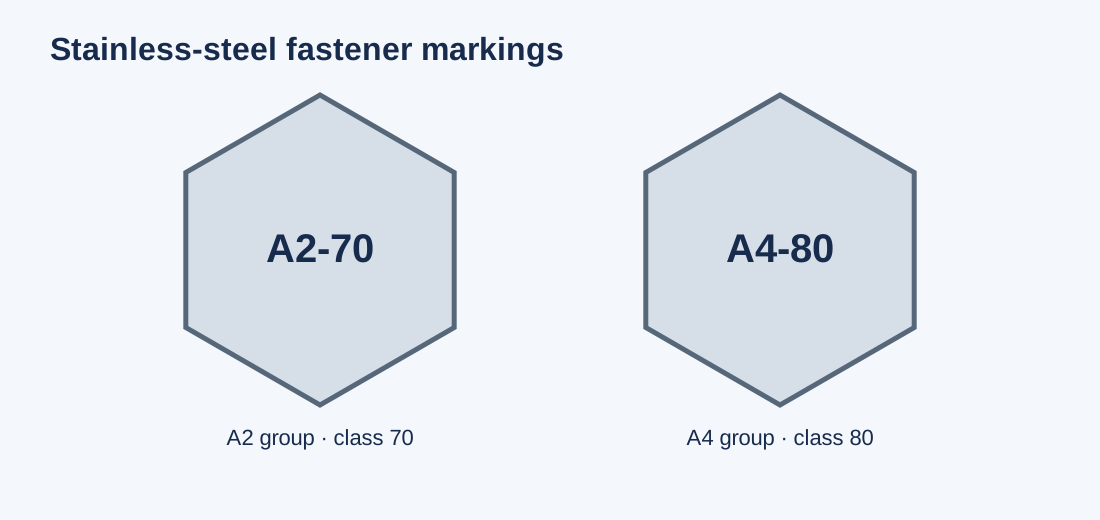
Not all fasteners use the 8.8-style marking system. Stainless-steel bolts frequently carry markings such as A2-70 or A4-80.
A2 identifies a stainless-steel grade group, commonly associated with corrosion-resistant austenitic stainless steel such as 304-type material.
70 indicates a minimum tensile strength of 700 MPa for the relevant fastener classification.
Similarly, A4-80 indicates an A4 stainless-steel group, commonly associated with molybdenum-containing 316-type stainless steel, with a minimum tensile strength of 800 MPa for the applicable classification.
| Marking | Material group | Minimum tensile strength |
|---|---|---|
| A2-50 | A2 stainless steel | 500 MPa |
| A2-70 | A2 stainless steel | 700 MPa |
| A4-70 | A4 stainless steel | 700 MPa |
| A4-80 | A4 stainless steel | 800 MPa |
These markings are covered by standards such as ISO 3506. Material grade, size, manufacturing method, and product standard must also be considered.
For installations exposed to Kerala's humid or coastal conditions, corrosion resistance is particularly important. However, even stainless steel must be selected according to the actual environmental exposure.
6. Metric Bolt Grades vs American SAE Bolt Grades
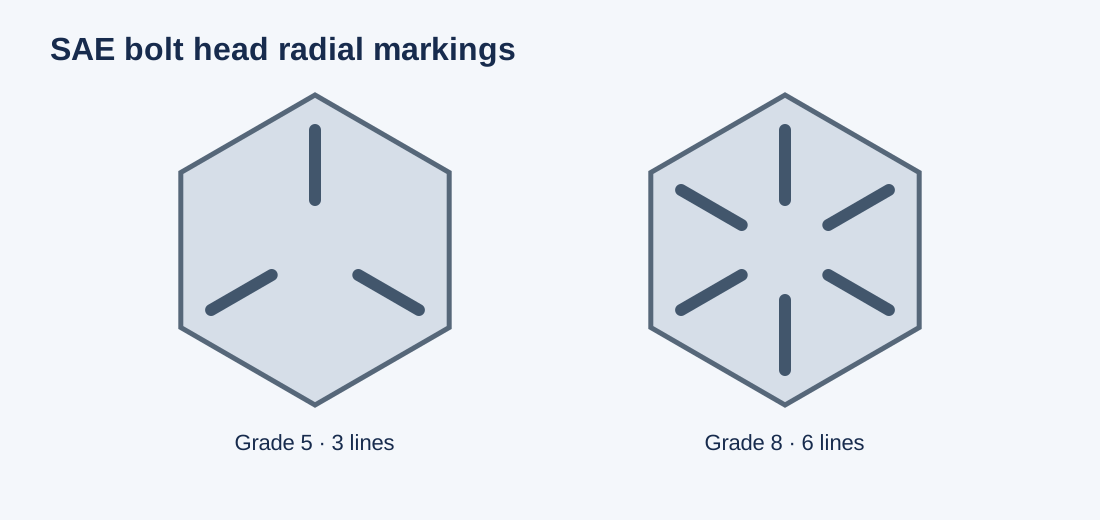
You may also encounter bolts without decimal numbers but with raised radial lines on their heads. These are often American SAE inch-series bolts.
- SAE Grade 5: Three radial lines on the bolt head.
- SAE Grade 8: Six radial lines on the bolt head.
Under common SAE J429 head-marking conventions, these lines identify the grade. SAE grades are not identical to metric classes 5.6 or 8.8. The two systems use different specifications, strength requirements, and dimensional conventions.
7. What Does M8 × 1.25 × 40 Mean?
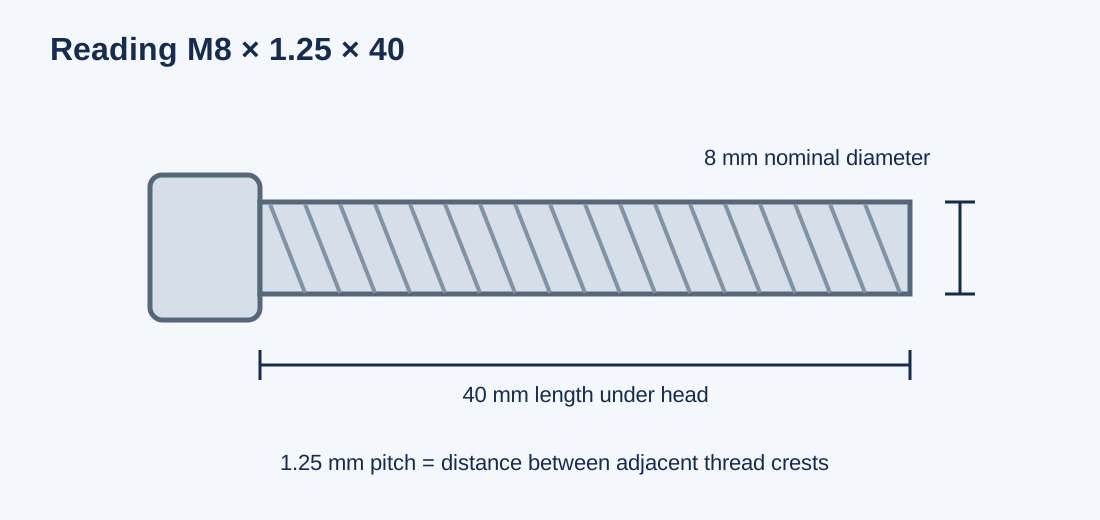
Another important marking you may find on a bolt package, drawing, or specification is M8 × 1.25 × 40.
This is a dimensional designation, not a strength grade.
- M8: Metric thread with an 8 mm nominal diameter.
- 1.25: Thread pitch of 1.25 mm, meaning the distance between adjacent thread crests.
- 40: Nominal bolt length of 40 mm, generally measured from beneath the head for a standard hex-head bolt.
Therefore, an M8 × 1.25 × 40 bolt is an 8 mm nominal-diameter metric bolt with a 1.25 mm thread pitch and a 40 mm length. It could be manufactured in different strength classes, such as 8.8 or 10.9.
8. How to Identify a Bolt Correctly on Site
- Check the head marking. Look for numbers such as 8.8, 10.9, 12.9 or radial lines. Check for manufacturer identification marks.
- Measure the diameter. Use a vernier caliper to measure the outside thread diameter.
- Check the thread pitch. Use a thread-pitch gauge to determine whether the bolt has coarse or fine threads.
- Verify the material and grade. Compare the markings against manufacturer documentation, drawings, and relevant standards.
- Confirm application requirements. Check the specified bolt and nut grades, corrosion protection, washer requirements, and tightening procedure.
A missing or unreadable marking does not automatically mean a bolt is defective. Some smaller fasteners are exempt from certain marking requirements. However, an unidentifiable bolt should not be used in a safety-critical connection without suitable verification.
9. Common Mistakes When Selecting Nuts and Bolts
One common mistake is assuming that all bolts of the same diameter have the same strength. Two M12 bolts may look identical but have very different mechanical properties.
Another is using a high-strength bolt with an incompatible nut, potentially causing thread stripping before the required bolt performance is achieved.
A third mistake is assuming that a higher grade always allows greater tightening torque. Correct torque depends on the joint design, bolt size, lubrication, surface condition, and installation specification.
Finally, using ordinary unprotected steel fasteners in corrosive environments can lead to premature deterioration, particularly in outdoor and coastal installations.
10. Why Bolt Identification Matters in Construction and Engineering
Correct fastener identification is essential across multiple engineering disciplines.
In structural engineering, bolts transfer forces between connected steel members. Incorrect selection can compromise the connection's intended performance.
In mechanical engineering, fasteners hold equipment, motors, pumps, and machinery in position while resisting operating loads and vibration.
In electrical installations, bolts secure panel boards, equipment supports, cable-tray brackets, and busbar connections. For electrical joints, material compatibility, contact pressure, and the manufacturer's tightening instructions are especially important.
At V4 Building Solutions, we believe that understanding even the smallest engineering components contributes to better construction quality, safety, and long-term reliability.
11. Quick Reference: Understanding Fastener Markings
| Marking | Meaning |
|---|---|
| 4.6 | Metric steel bolt property class |
| 8.8 | Metric bolt, nominal tensile strength 800 MPa |
| 10.9 | Metric bolt, nominal tensile strength 1,000 MPa |
| 12.9 | Metric bolt, nominal tensile strength 1,200 MPa |
| 8 on a nut | Metric nut property class 8 |
| 10 on a nut | Metric nut property class 10 |
| A2-70 | Stainless-steel fastener, strength class 70 |
| A4-80 | Stainless-steel fastener, strength class 80 |
| M12 × 1.75 | Metric thread, 12 mm nominal diameter, 1.75 mm pitch |
| Three radial lines | Common SAE Grade 5 bolt head marking |
| Six radial lines | Common SAE Grade 8 bolt head marking |
Conclusion
The small numbers stamped on nuts and bolts carry important engineering information.
A marking such as 8.8 or 10.9 is not simply a number. It identifies a standardized mechanical property class that helps engineers select appropriate fasteners.
Similarly, nut markings, stainless-steel classifications, and thread dimensions all play a role in ensuring that a connection is properly designed and assembled.
The next time you pick up a bolt, take a moment to inspect its head. Those tiny markings can tell you a great deal about the fastener you are holding.
In engineering, even the smallest component deserves the right specification.
At V4 Building Solutions, we promote practical engineering knowledge, quality construction practices, and technical awareness. For professional engineering, building design, and electrical services, contact our team.